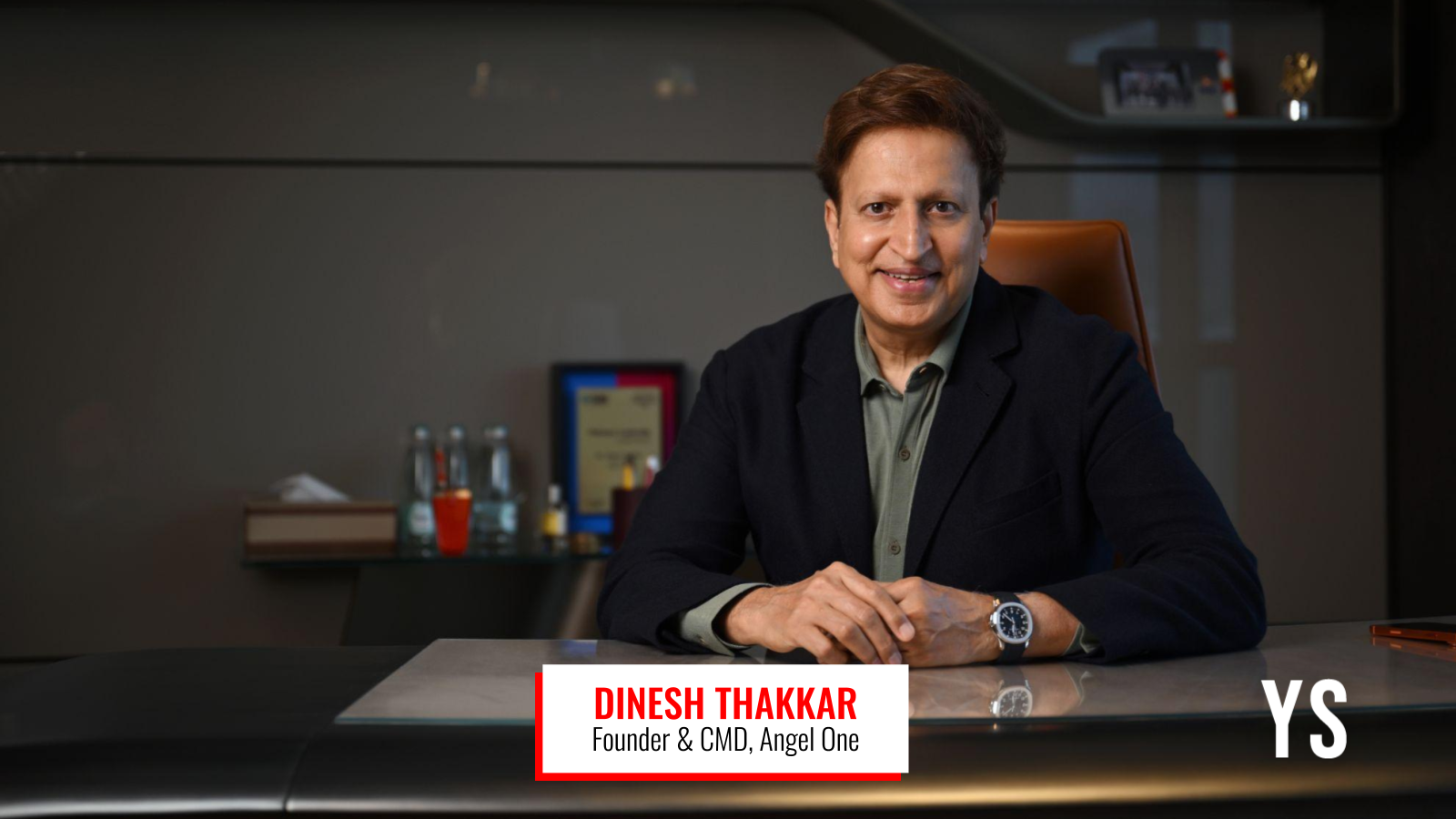
The year was 1996 when Angel One made its debut. Back then, stock broking was a high-adrenaline game that happened in a “pit” where brokers yelled and used complex hand signals to buy and sell shares. Angel One pioneered the use of walkie talkies that enabled investors to know the stock trades that were executed on their behalf. Cut to 2026, outcry pits have given way to silent algorithms that make trades in milliseconds. Retail investors can now access real-time analytics via a smartphone screen. Despite the vast technological disruptions that have sidelined legacy companies, Angel One has managed to remain relevant. Today, Angel One has a user base of 3.95 crore despite intense competition from new players such as Zerodha and Groww. It is now actively exploring AI to further improve user experience. In an interview withYourStory, Founder, Chairman and Managing Director Dinesh Thakkar and Group CEO Ambarish Kenghe discuss Angel One’s journey, its plans for the future and, more pertinently, its approach to AI. “Today, through AI, one can think about personalising every journey the way a person wants it, which I cannot imagine otherwise,” he says. Dinesh Thakkar (DT):Before Angel One was really incorporated, we were reading about computers in the mid-1980s, when India was getting ready to open up the market for the use of computers. That is where a thought came to my mind that this is a powerful instrument. How can we use it in any business? I borrowed some money from my friends and entered the stock market but got badly bruised, losing 50% of my capital. For a newcomer, there was a lag in getting information on how and when stock trades were executed. The first thing I wanted to see was how the whole process could be made transparent, where one could get confirmation of a stock purchase or sale in real time. This was when I introduced the walkie-talkie, through which a customer’s order could be confirmed within five to 10 minutes. We also built software on our computers so that customers were given the contract note by the end of the day. My point was to always look at what users want. My philosophy is: don’t get too fascinated by technology; use it to solve a problem. When screen-based trading started, we started investing in routers, VSATs and modems to extend our services to other terminals. When I heard about internet trading becoming popular in the US, that is when I started working on how I could bring this experience to people here. In 2000-01, I went very aggressive because I was very excited by this technology. This was the first time I made a mistake in terms of not realising that technology was there, but not for other users. We invested heavily in internet trading, but our vendor could not provide the software as its parent company had different priorities. We suffered huge losses, with a lot of unused hardware. That is where I realised that I was too attracted towards technology while users did not have a personal desktop to do inter