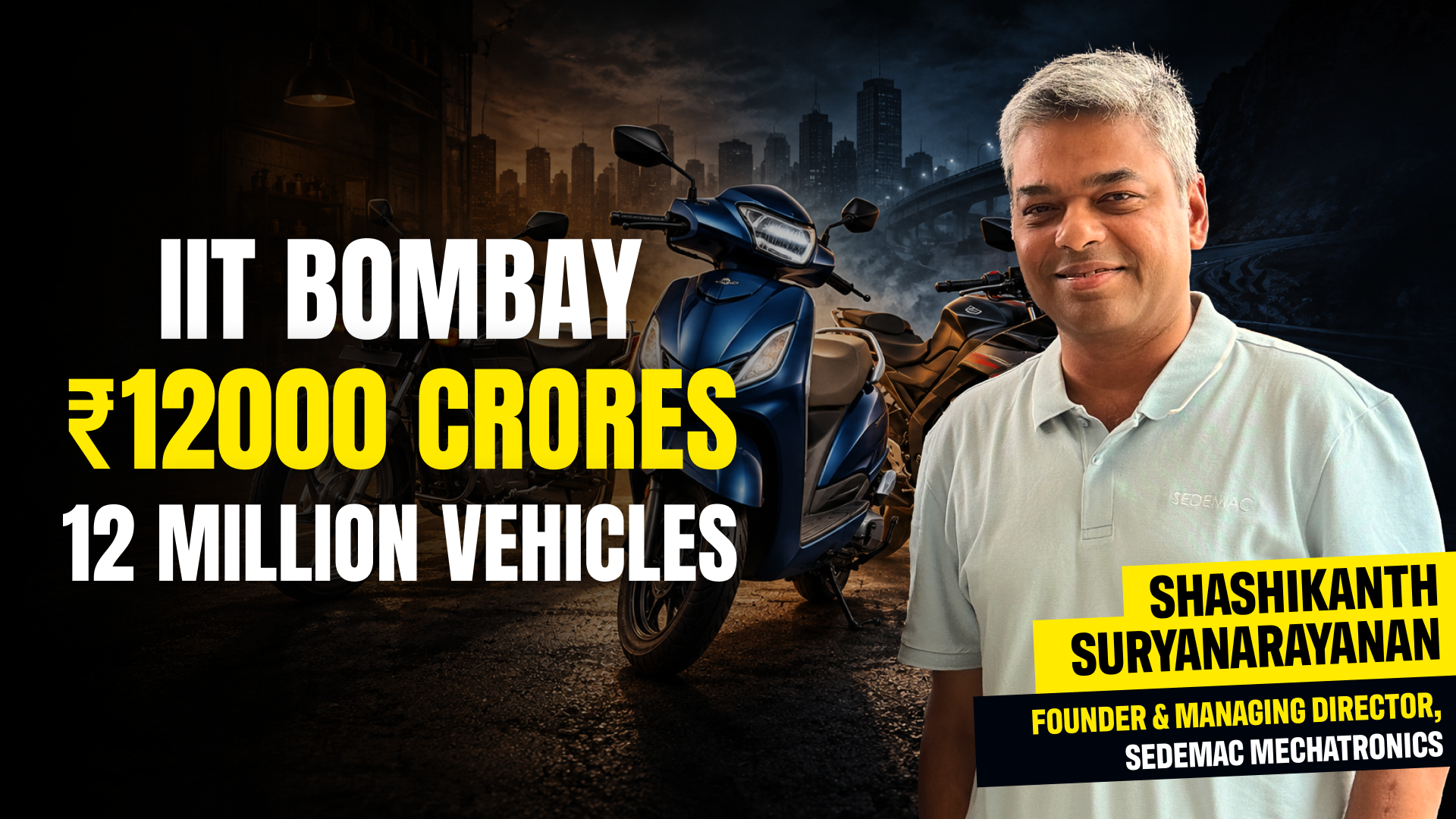
India’s startup ecosystem has become very good at building companies at speed. Professor Shashikanth believes building genuinely new technology is a different game altogether. Nearly two decades ago, a group emerging from an IIT Bombay lab started Sedemac with an ambition that sounds deceptively simple: build new control technologies and see them achieve widespread adoption. Today, the numbers tell a remarkable story. Sedemac has crossed Rs 1,000 crore in annual revenue, with around Rs 200 crore in EBITDA, Rs 150 crore in profit before tax and Rs 100 crore in profit after tax. The company operates at roughly 40% return on capital employed, ships one million motor controllers every quarter, and its technology sits inside millions of two-wheelers on Indian roads. But Shashikanth’s story is less about one company’s growth and more about what happens when engineers attempt something that the market itself may not yet know it needs. “Creators of technology are market creators,” he says. “You don’t start with, ‘Oh, this market is going to grow big.’ Therefore, it will grow big or not because of you.” At the heart of Sedemac’s growth is its work on motor controllers and sensorless commutation. A motor controller manages the flow of power between a power source such as a battery and an electric machine. For that motor to operate, the controller needs to determine which coils should be energised based on the position of the rotor. Conventionally, a physical sensor can provide that information. Sensorless commutation attempts to do this without such a physical position sensor, instead estimating the rotor’s position using other information. At higher speeds, this has been understood for decades. At zero and low speeds, the physics becomes significantly harder because one of the phenomena used for estimation, back EMF, reduces with speed and disappears at zero speed. “We are the first company globally, globally, it is a very big statement, that has made as much progress in sensorless commutation as we have,” says Shashikanth. But Sedemac did not start in 2007 with a grand plan to solve this particular problem. The opportunity emerged years later through its work with the two-wheeler industry. Around 2014-15, while developing an Integrated Starter Generator or ISG, the team realised the system could be improved if it made progress on sensorless commutation. In 2018, a TVS moped became the first vehicle to use the system. According to Shashikanth, it was also the world’s first sensorless ISG application. What followed was not an overnight deep-tech success story. Sedemac estimates that 12 to 13 million vehicles carrying its ISG are now on Indian roads. Five of the top 10 two-wheeler models selling in India use its ISG in at least one variant, including models from TVS, Bajaj and Hero. Another Sedemac technology, Shashikanth says, has already gone into around 50 million vehicles. This scale matters because Sedemac had to break into an industry dominated by eno


