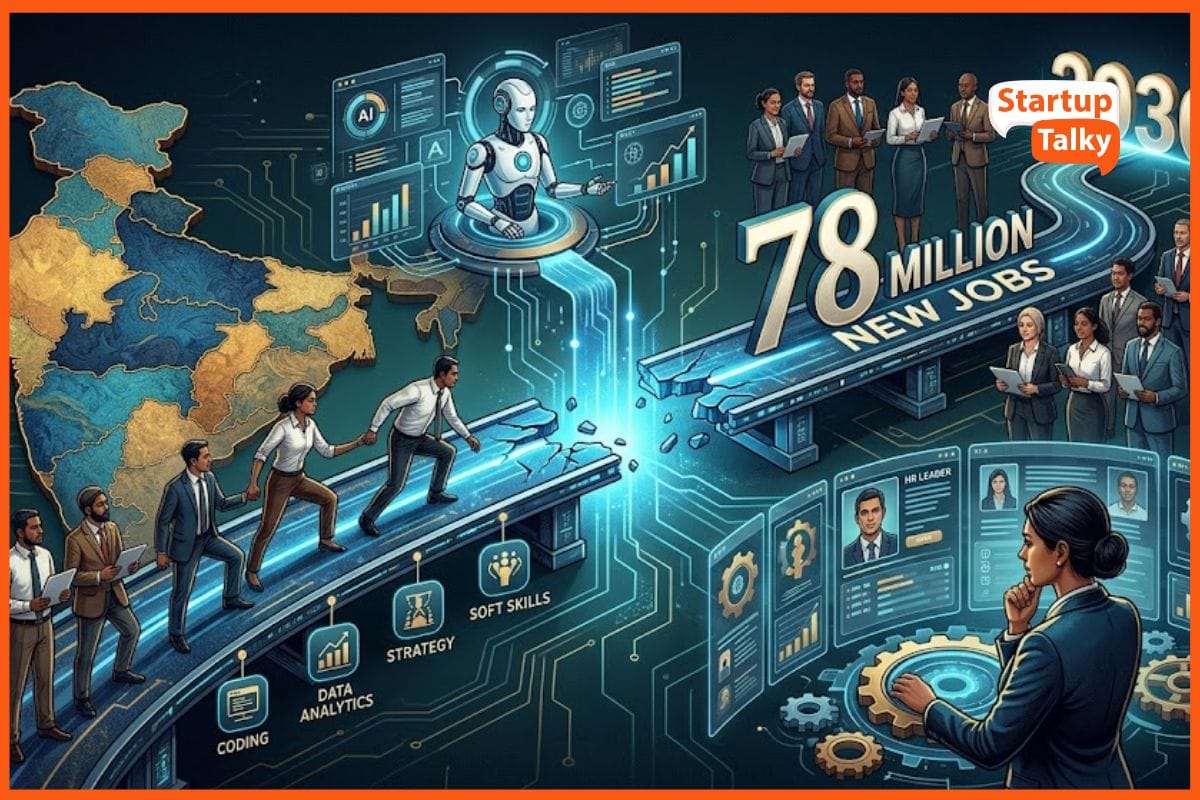
On International HR Day 2026, StartupTalky explores how AI is reshaping hiring, skills, and the future of work. While 78 million new jobs are expected globally by 2030, India faces a widening gap between AI adoption and workforce readiness, raising urgent questions for businesses and HR leaders. In 2025, the World Economic Forum’s Future of Jobs Report delivered a stark projection: 22% of global jobs will be disrupted by 2030. Not gradually replaced but disrupted. At the same time, 170 million new roles are expected to emerge, against 92 million jobs that could disappear, creating a net gain of 78 million jobs. But that opportunity comes with a condition: skills readiness. In India, the urgency is sharper. The country recorded 290,000 AI-linked job roles in 2025, with demand expected to grow by over 30% in 2026. Skills in generative AI and large language models surged by nearly 60% year-on-year. Yet, globally, only 58 million workers completed AI training in 2025, against an estimated 1.4 billion people who need reskilling by 2028. That’s just 4.1% of the required workforce readiness. This widening gap between AI adoption and workforce preparedness is where the real story lies. On International HR Day 2026, StartupTalky spoke with HR leaders, founders, and global experts to understand how AI is reshaping hiring, skills, and the future of work, not in theory, but on the ground. The case for AI in hiring becomes clearest when viewed through the lens of India’s frontline workforce. With over400 million frontline workers,the largest such workforce globally, the scale of hiring has long outpaced human capability. High attrition rates, fragmented talent pools, and multilingual communication challenges have made traditional recruitment models inefficient and expensive. Khandelwal’s Gurugram-based platform has facilitated over 21 million candidate conversations in Hindi, Marathi, and other regional languages, entirely via voice AI on ordinary phone calls, no app, no data plan required. This was a deliberate design choice rooted in inclusion, not convenience. “Every AI hiring tool built on apps, portals, and PDF uploads quietly excluded India’s frontline workforce. The answer was always simpler: start where the worker already is. In India, that’s a phone call,” Khandelwal. Beyond scale, the economics are equally compelling. Frontline attrition across sectors like logistics, retail, and manufacturing ranges between25-35%, while hiring costs can reach40-60% of annual salariesfor these roles. AI is not just reducing time-to-hire; it is fundamentally changing how recruitment resources are allocated. Khandelwal highlighted, “The 10,000 recruiters aren’t disappearing, they’re graduating. Today, recruiters spend nearly 70% of their time on coordination, follow-ups, scheduling, and screening calls across languages. AI absorbs that. What remains is the work that actually requires human judgment.” In this model, AI does not eliminate human roles; itredefines them.