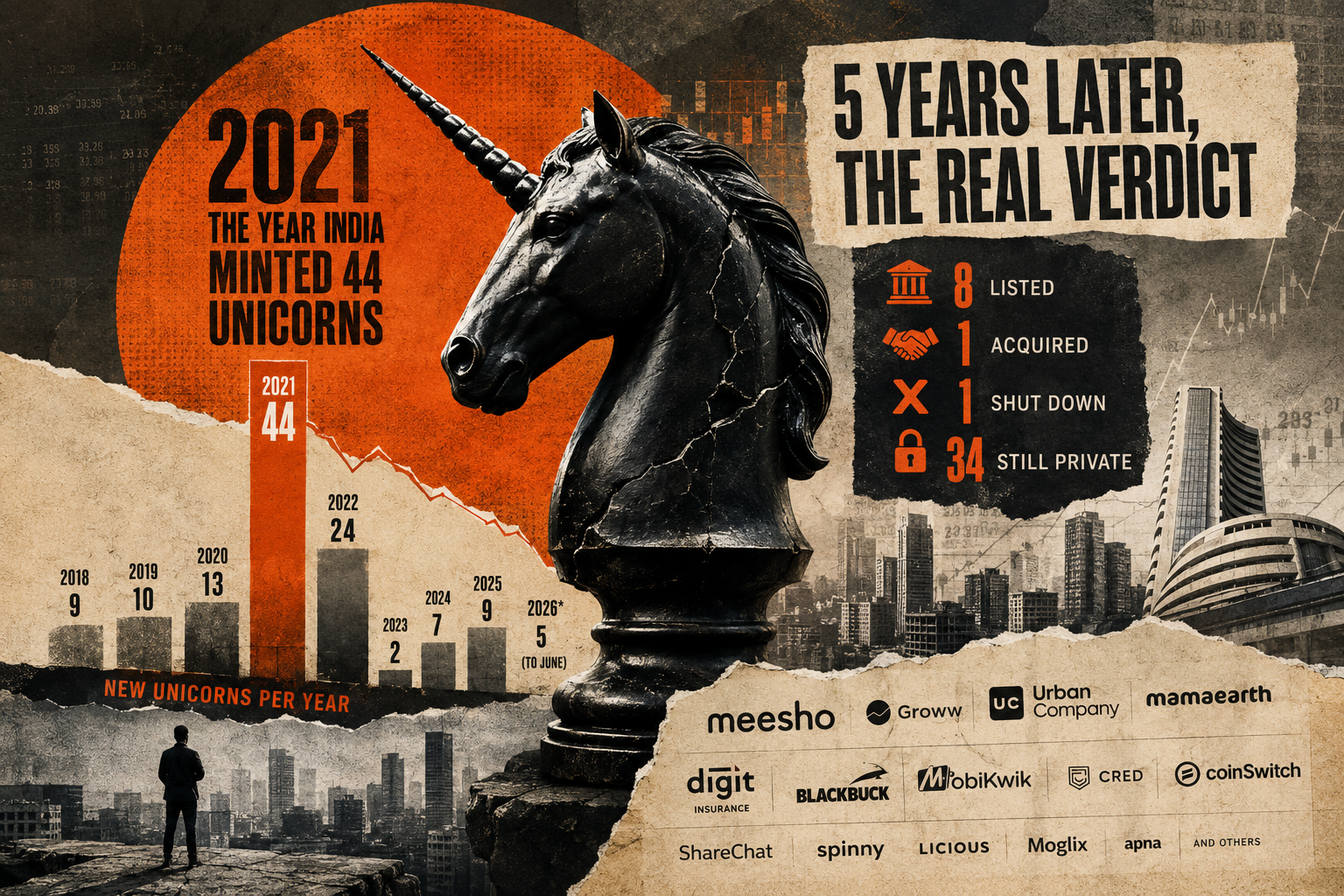
A third of every Indian unicorn that exists today was crowned in a single year. We took Tracxn's full list of 132 Indian unicorns, isolated the 44 minted in 2021, and traced where each one stands five years on. In 2021, India turned a company into a unicorn roughlyevery eight days. Forty-four of them crossed the billion-dollar line that year, more than the previous three years put together. Then the tap closed. In2023, the entire country produced two. New unicorns minted per year, per Tracxn (132-company set, retrieved 29 June 2026). Read the table once and the story is plain. 2021 was not a good year. It was an outlier so large that it distorts the whole decade. The Class of 2021 is, by itself,33 percent of every Indian unicorn alive today, and what happened to those 44 companies is the closest thing the ecosystem has to a controlled experiment: same vintage, same euphoric capital, five years to prove it. The unicorns were a symptom. The cause was the capital. Across the companies in this dataset,$27.9 billion flowed in during calendar 2021, over 185 rounds, the single biggest year of venture funding India has seen. The next year it nearly halved. The year after that it fell off a cliff. Capital raised by these unicorns by calendar year, per Tracxn funding-round records. A unicorn is made the moment an investor agrees to a valuation. In 2021, investors agreed to almost anything. Tiger Global alone wrote into a third of the eventual unicorn list. The crowning was not a verdict on the businesses. It was a verdict on the market. Which is exactly why the five years since are the interesting part: that is when the businesses had to answer for the price. Five years on, the 44 sort into four piles. Eight IPOs, one trade sale, one death, and a large private middle that has neither listed nor failed. The two ends of that table are the entire argument about whether 2021 was a bubble or a beginning. Both ends are real. Eight of the 44 made it to the public market, and the timing tells its own story. Only one listed during the boom itself. The rest waited out the winter and went out in the 2024 to 2026 window, when public investors had stopped paying for growth alone and started asking for a path to profit. Eight public listings out of one cohort is not a failure rate. It is the highest graduation rate of any unicorn vintage India has produced, precisely because the cohort was so large. A third of the club came from one year, and a quarter of that third has already found the exit that the previous decade of Indian startups mostly could not. Then there is the part the celebratory version leaves out. Of the 34 still private, a cluster hasnot raised fresh primary capital since 2021 or 2022. Their last priced round is also their unicorn round. They are carried, on paper, at a number the market set at the very top. This is where honesty matters, because "has not raised since 2021" means two completely different things. For some, it is a sign of strength.BrowserS


