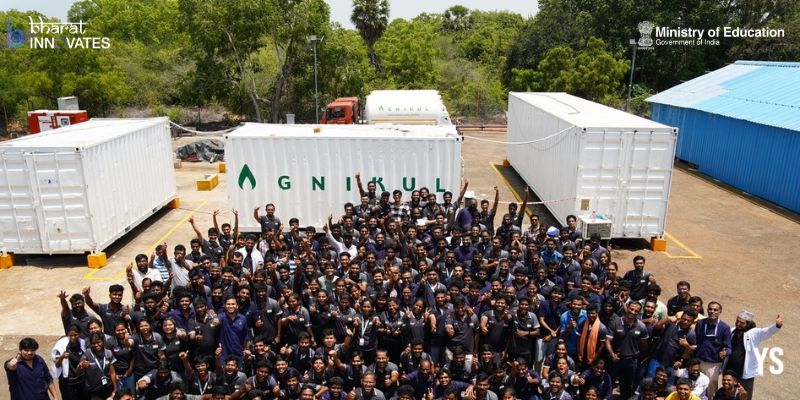
India's ambition to lead in space is no longer just a government story. ThroughBharat Innovates 2026, theMinistry of Educationis backing a new generation of private deep-tech companies building critical technologies from the ground up, and showcasing them to global investors and partners at an event in Nice, France, from 14 to 16 June 2026. The initiative spans 13 frontier sectors, including Space, Advanced Computing, Semiconductors, Defence, and Manufacturing and Industry 4.0, and brings around 120 R&D-backed ventures before industry leaders and policymakers as part of the India-France Year of Innovation. That ambition is being built on a foundation that has been quietly strengthening for years. Reforms under the National Education Policy 2020, international research partnerships through SPARC, and the Study in India initiative are collectively reshaping what Indian institutions produce and who they attract. In the QS World University Rankings 2026, 54 Indian institutions made the list, with IIT Madras climbing 47 places to 180 and IIT Delhi reaching its best-ever 123rd position. India now ranks fourth globally by institutions represented, and is the fastest-growing higher education system in the G20 over the past decade. Among the companies receiving recognition under Bharat Innovates 2026 is Agnikul Cosmos, building technology that is making space more accessible for a new generation of satellite missions. For small satellite companies, getting into space has often depended on compromise. Most are forced to hitch rides on large rockets, wait months for launch windows, and adjust missions around the priorities of bigger payloads. The result is an industry where access to space remains expensive, inflexible, and slow-moving for smaller players. But as demand for satellite launches accelerates, driven by communication, climate monitoring, defence, and earth observation, the need for faster, on-demand launch solutions has become impossible to ignore. Founded in 2017,Agnikul Cosmoswas created to address that gap. The idea emerged when Co-founder and CEOSrinath Ravichandran, then based in Los Angeles, noticed how difficult it was for small satellite companies to secure timely and affordable launch opportunities. Seeing an opportunity to build more responsive launch solutions, Ravichandran teamed up with Co-founder and COOMoin SPM. The duo began connecting with experts and exploring access to testing infrastructure in India before eventually setting up the company in Chennai, where they found a home at the IIT Madras Research Park, one of India's most active technology incubation ecosystems. Agnikul Cosmos set out to build Agnibaan, a small-lift launch vehicle capable of carrying payloads of up to 100 kg to a 700-km orbit. But the company's biggest breakthrough lay not just in the rocket itself, but in how it was built. Traditional rocket engines are made from hundreds of separate parts that require complex manufacturing and assembly processes. Agnik