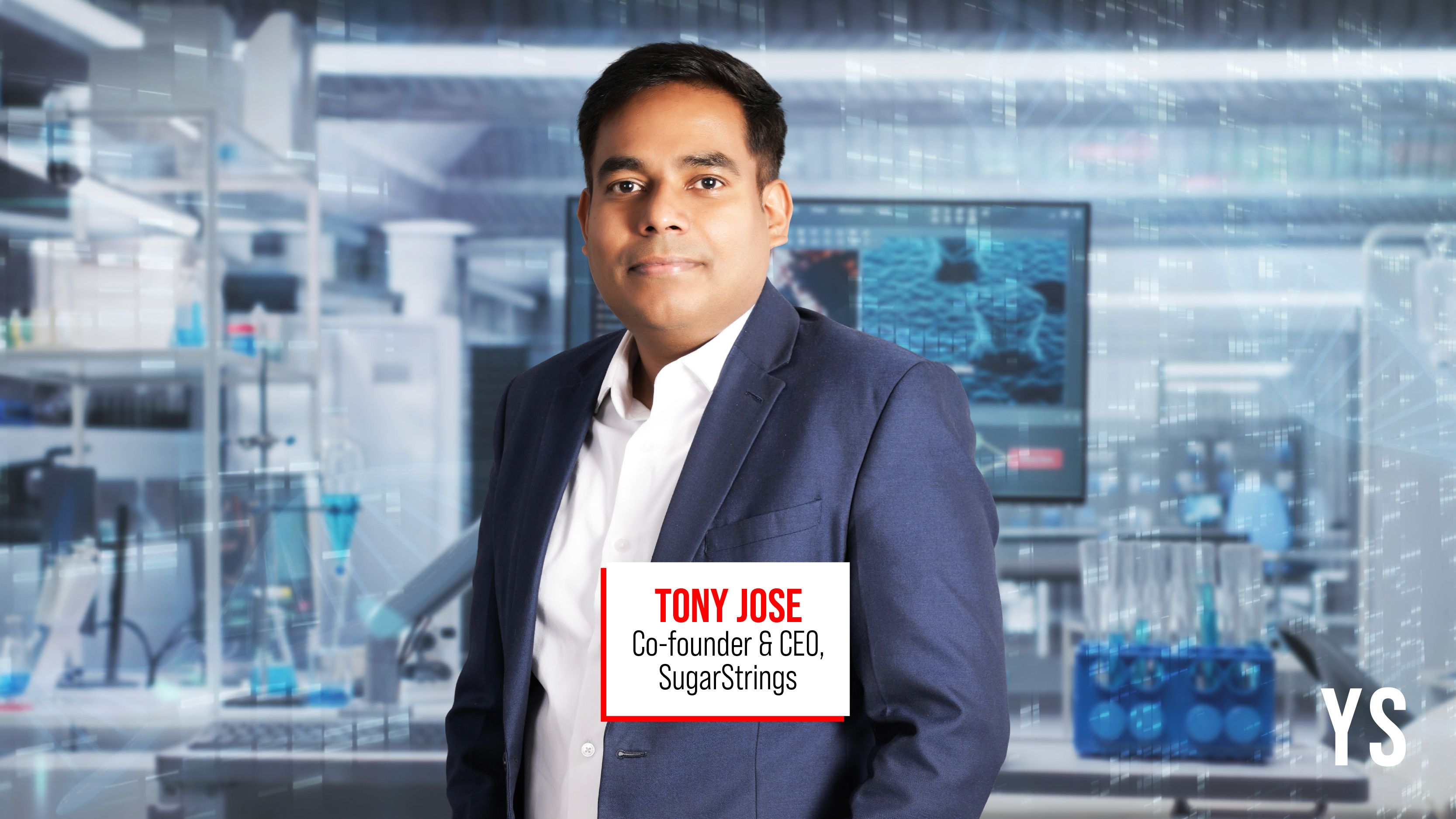
For years, Tony Jose worked in genomics research and diagnostics, studying how genetic conditions shape human health. During his time as CEO of Clevergene Biocorp, one observation kept returning. Many genetic disorders may be classified as rare, but together they affect far more people than most people realise. “Genetic disorders are essentially rare diseases. But while they are individually rare, as a group it becomes a burden on the population. For instance, hypertension is considered a lifestyle disease now but there are cases of genetic conditions that can lead to its onset,” Jose tellsYourStory. That insight led Jose and Rajasekhara Reddy Ravuri, then Chief Scientific Officer at Clevergene Biocorp, to launch Bengaluru-based SugarStrings in 2023. The startup takes its name from DNA’s sugar backbone (deoxyribose), and aims to help people better understand their genetic predisposition to disease through a single DNA test. “We realised SugarStrings would be the best way to actualise our idea for the mainstream, enabling people to screen themselves, understand their genetic predispositions, and work on preventing or managing them,” says Jose, now CEO of SugarStrings. Apart from Jose and Ravuri, the six-member founding team includes co-founder Dhaneesh Jameson. While Jose and Ravuri have stepped away from executive roles at Clevergene Biocorp, Jose continues to serve as its director. SugarStrings’ flagship product, Healthstring, is a DNA sequencing test that analyses a cheek swab sample to screen for more than 7,442 genetic disorders in a single test. Unlike blood-based tests, the company uses cheek swabs for sample collection. "The non-invasive approach is easier for sample collection, bypasses challenges like cold chains, and has a psychological advantage—people are more proactive about their health when they can self-collect samples," Jose says. In the last five years, the cost ofDNAsequencing has become roughly one-third of what it used to be. The test now costs Rs 58,000, with reports delivered between five days and one month. According to Jose, the company goes beyond identifying an individual's likelihood of developing a condition. “We don’t just provide the likelihood of developing a disease. We go through the DNA sequencing, find the exact mutation, and create a detailed report on all the possible diseases that can come from that mutation. The report is such that clinical action can be taken referring to it,” he says. HealthString screens for 7,442 disorders, including 188 hereditary cancers and 302 cardiovascular diseases. By comparison, Jose says New York-based Nucleus Genomics screens for around 2,100 disorders, while Bengaluru-based Strand Life Sciences screens for about 250. The company has deliberately chosen to offer a comprehensive test rather than condition-specific screening. “The key reason we are sticking with a comprehensive test is because the human body is a connected system where diseases affecting a primary organ can have
Related Stories
 Lam Research to invest Rs 10,000 Cr in India, set up first silicon component man
 Kissht parent OnEMI board approves Rs 832 crore preferential issue
 Taruwar Agro: Three Bihar Friends Built a Rs 2.5 Crore Business from Banana Wast
 Adidas Confirms Job Cuts at India Tech Hub, Nearly Half of Employees Affected