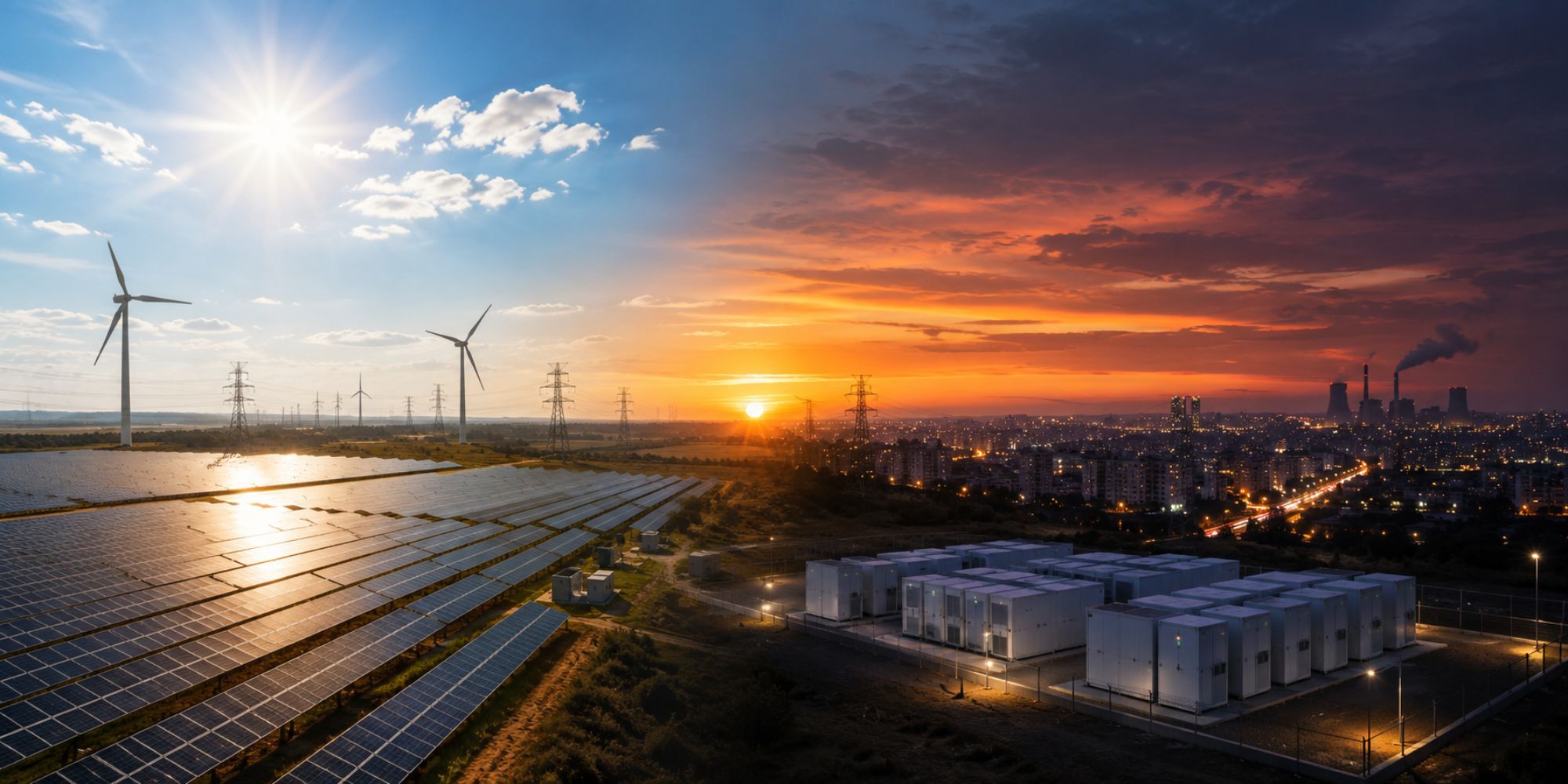
At 11:46 am on 6 July 2026, India's power grid crossed a line it had not crossed all year. Clean energy sources, meaning renewables together with hydro and nuclear, met 50.02% of the country's electricity demand of 221.5 GW, according to the Ministry of Power's MERIT platform. It was the second consecutive year that clean power took more than half the load at a single point in time. It also lasted minutes. By dinner, coal was back in charge. India's energy storage market is racing to close that gap, but the cheaper answer to it is a market almost nobody in India has built yet. The generation story is genuinely won. As of 31 May 2026, India's total installed power capacity stood at 542.3 GW, with renewables at 282.7 GW, now comfortably ahead of thermal at 250.8 GW. The country crossed 50% non-fossil installed capacity in 2025, five years ahead of the commitment made at COP26. On the metric that gets celebrated, India has overdelivered. Peak demand tells a harder story. On 21 May 2026, India recorded its highest ever peak of 270.8 GW. Renewables including hydro contributed 34% of it. At the April peak, fossil fuels still accounted for close to 69%, according to the Institute for Energy Economics and Financial Analysis. India's demand peaks in the evening, when cooling loads stay high and the sun has already gone. Solar, which does the heavy lifting at midday, contributes nothing at 9 pm. Even the world's largest renewable energy park has hit this wall. Adani Green's Khavda site in Kutch spreads across 538 sq km, roughly five times the size of Paris, and is being built out to 30 GW by 2029, of which 9.9 GW is already operational. To make that power useful after dark, Gautam Adani's group commissioned 3.37 GWh of battery storage there in May 2026, which it describes as the largest single-location deployment outside China, delivered in 10 months. The company plans to add over 10 GWh in FY27 and reach 50 GWh within five years. Why does clean power disappear after sunset Electricity cannot sit in a warehouse. It has to be generated at the moment somebody switches on a light. Solar is cheap and abundant, but it arrives on a schedule set by the sun. Generation peaks around noon, when demand is moderate, and falls to zero by early evening, exactly when demand climbs. Grid engineers call the resulting shape the duck curve. There are only three ways to fill the evening hole. Store the day's surplus and release it at night. Generate at night from wind, hydro or nuclear, which do not need the sun. Or shrink the hole by moving demand into daylight hours. India is currently betting almost everything on the first. Where India's energy storage money is going The bet is being placed at speed. India's cumulative operational battery storage reached 8.5 GWh in the first half of 2026, an 11-fold rise in a year, after adding 7.9 GWh in six months, according to the India Energy Storage Alliance. Around 281 GWh has been tendered, with 105 GWh under execution. The Central
Related Stories
 From idea to enterprise: Designing startup programmes that deliver long-term imp
 Mirae Asset Venture Investments, others pay Rs 12.75 lakh to settle Sebi proceed
 CCPA Penalises Rapido INR 10 Lakh for Dark Patterns, Uber and Ola Under Scrutiny
 JanAI Technology launches with a plan to take AI to 100 million Bharat household