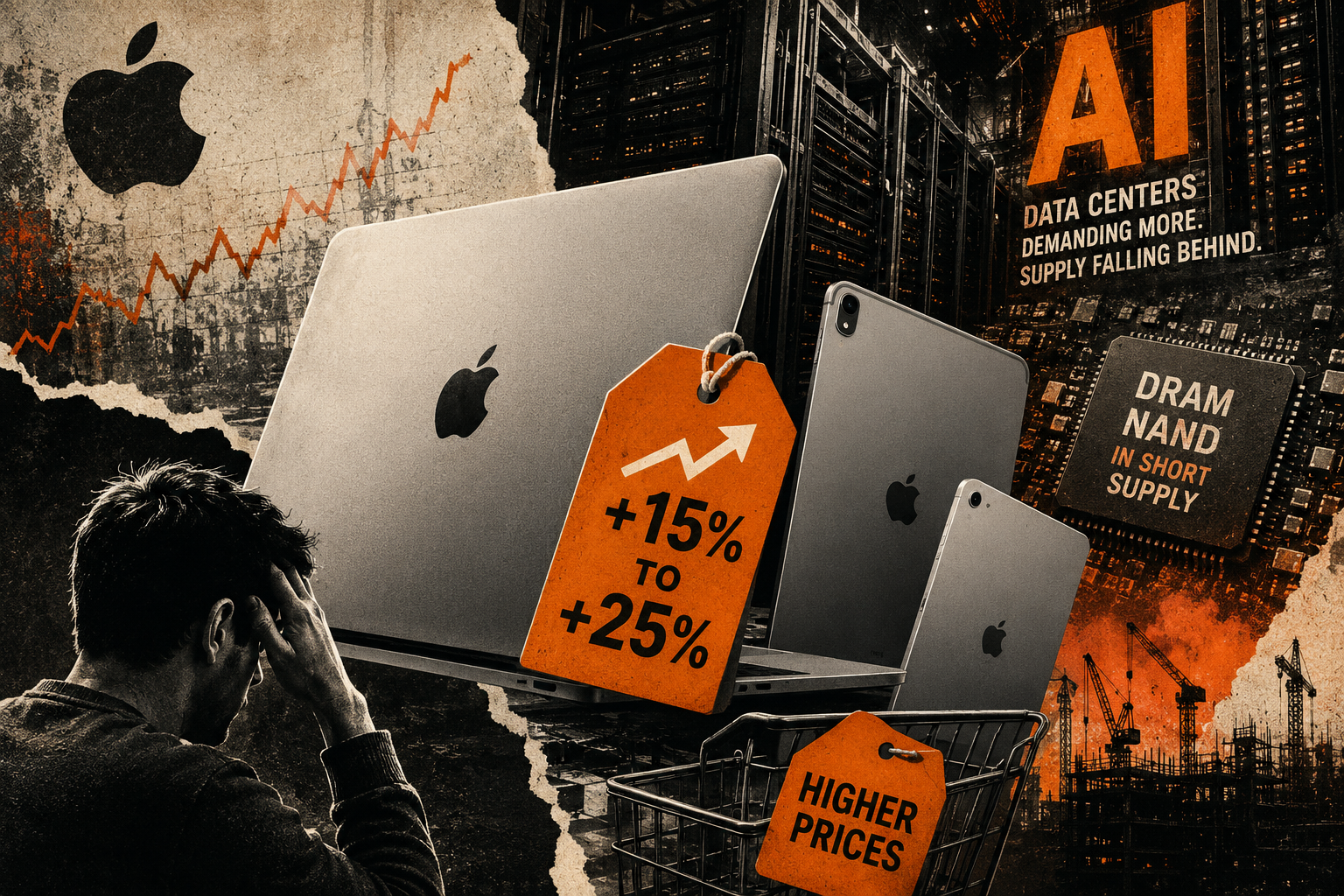
On 25 June 2026, Apple raised MacBook and iPad prices by 15% to 25%, its first formal move to pass the AI-driven memory shortage on to consumers. The stock fell more than 6%. For years the AI boom was a data-centre story. Today it became a price tag on your desk. For three years, the artificial-intelligence boom has been someone else's story: hyperscalers spending hundreds of billions on data centres, Nvidia minting trillions, power grids straining. It was abstract, and it was far away. On25 June 2026, it landed on the consumer. Appleraised the price of MacBooks and iPadsacross the lineup, by roughly15% to 25%, and told the world why in unusually blunt terms: the same memory chips that go into your laptop now go into AI servers, and AI is winning the fight for them. Apple's sharesfell more than 6%, their worst day since April 2025. Apple's online store briefly went dark on Thursday morning, then came back with new numbers. Across the range,Macs rose about 15% to 20% and iPads about 15% to 25%.The steepest jump, in percentage terms, hit the iPad Air. These are not the quiet, generational nudges Apple usually makes when it refreshes a product. They are mid-cycle increases on devices already on sale, which almost never happens. Apple framed it as a cost it could no longer absorb. CEOTim Cookhad warned a week earlier that increases had become"unavoidable."In its statement, the company said:"The consumer electronics industry is facing an unprecedented challenge. The rapid expansion of AI data centers has created an extraordinary surge in demand for memory and storage,"adding that it had"never seen a component price increase this much, this quickly." The key phrase is "first formal move." Apple had beenshielding customersfrom rising component costs, eating the increases to protect its prices. The June hike is the moment it stopped, and it hashinted that more may follow. The cause is a global shortage in the most boring, most essential component in electronics:memory. Generative AI runs on enormous quantities of high-speed memory (DRAM) and storage (NAND flash). As hyperscalers race to build AI data centres, they are buying memory at a scale and urgency no consumer-device maker can match, and they arediverting supply away from laptops, tablets and phones. The result is a price spike with few precedents: When the input doubles in three months, even a company with Apple's scale and supplier leverage eventually has to pass it on. A MacBook is, in significant part, a box of memory and storage wrapped in aluminium, and the box just got far more expensive to fill. This is a transfer of value, and it is easy to see in whose direction. Thewinners are the memory makers. ChipmakerMicron just reported quarterly revenue more than quadrupling, the memory crunch showing up directly in its financials, and its peers Samsung and SK Hynix are riding the same wave. For them, AI demand plus tight supply is the best pricing environment in years. Thelosers are buyers and dev