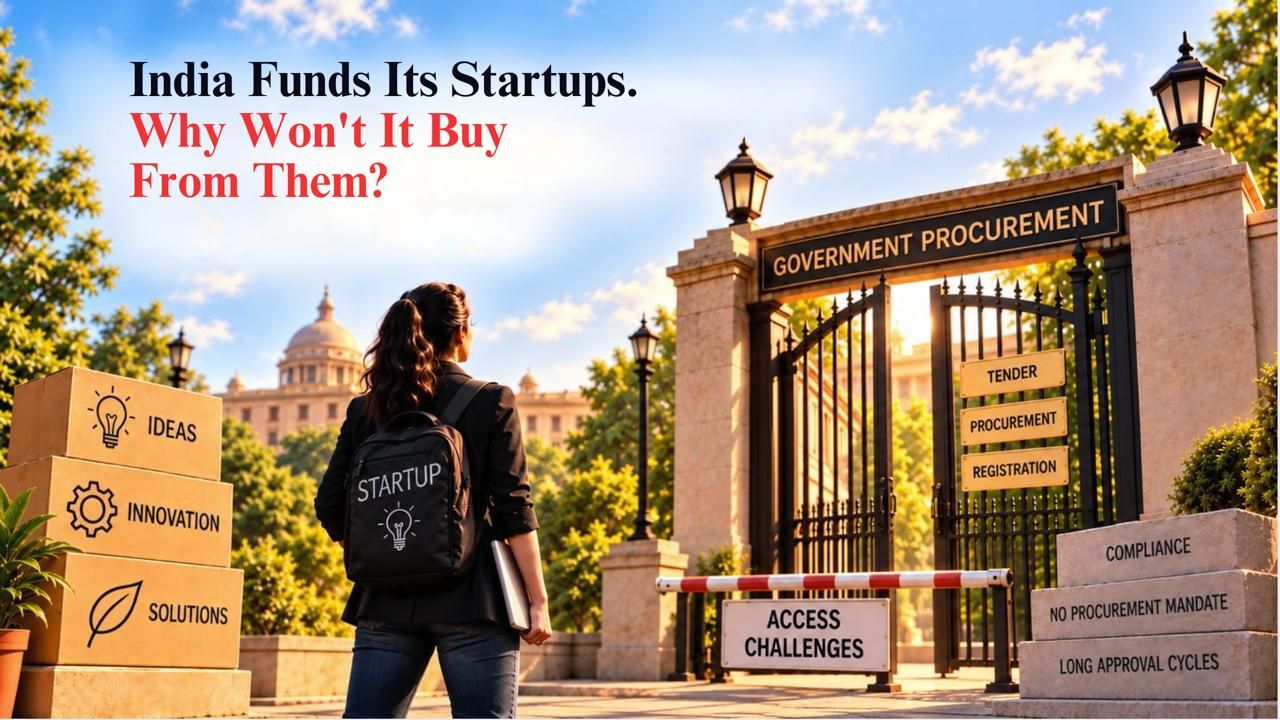
India has spent a decade asking its young people to build. It created funds, grants, incubators, tax incentives, credit guarantees, challenges and accelerators. More than two lakh startups have been recognised. But when those startups finally build something that works, they run into a far harder question: who will buy it? The Government e-Marketplace handled purchases worth ₹5.03 lakh crore in FY26. Startups received just over ₹19,000 crore, less than four per cent. Fewer than one in five recognised startups is even registered as a government seller. This is the contradiction at the heart of India's startup story. We have built a state that is increasingly comfortable funding innovation and remains deeply uncomfortable buying it. A grant can help a startup build a prototype. Only a customer can help it build a company. And in energy, healthcare, climate technology, mobility, defence and infrastructure, the government is not merely one possible customer among many. It is often the only first customer large enough to create the market at all. The gap is not evidence that startups build things the government does not need. It is the predictable output of policy design. Micro and small enterprises cross 47 per cent because a mandate exists. Every central ministry, department and public sector enterprise must source at least 25 per cent of annual procurement from MSEs, with carve-outs of four per cent for SC/ST-owned units and three per cent for women-owned units. Across CPSEs and departments in 2024-25, MSE procurement reached ₹93,017 crore, or 43.58 per cent, comfortably above the floor. Startups are the only priority category in Indian public procurement that received relief on the entry side and nothing at all on the buyer side. Rules 170 and 173 of the General Financial Rules exempt recognised startups from earnest money deposits and allow relaxation of prior turnover and prior experience. No buyer was ever given a target, a budget line or a reporting obligation to actually purchase. MSEs have a procurement mandate. Startups have exemptions. One tells the buyer: you must buy. The other tells the startup: you may apply. India changed the rules of entry. It did not change the incentives of the buyer. The result shows in the only long-run figure available: the Standing Committee on Commerce found that ten per cent of recognised startups had transacted on GeM at all, worth ₹14,000 crore across eight financial years. On 19 August, in an auditorium at IIT Madras, Petroleum Secretary Neeraj Mittal made a promise to a room full of deep-tech founders. Around thirty energy startups would each become eligible for up to ₹2 crore in milestone-linked convertible funding under a new accelerator, MC2+ Ignite, plus pilot sites inside the research centres of the oil and gas PSUs. They would also get visibility that a PSU will procure their product when it is ready. They should not, he said, have to worry about whether a market exists. The chairmen of ONGC, Oil In