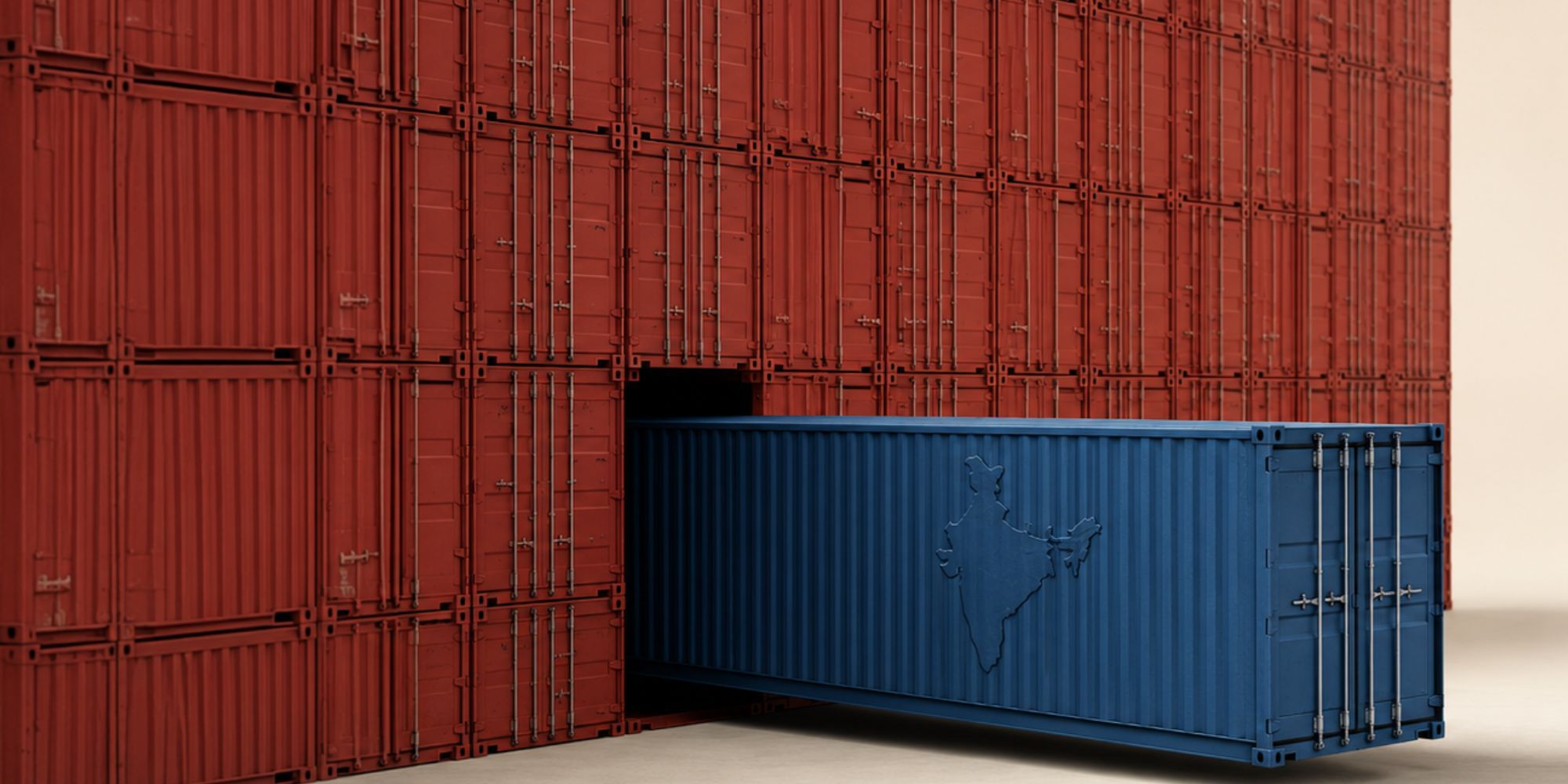
Nearly every good you've bought that arrived by sea travelled inside a steel box built almost entirely in one country. Chinese manufacturers produce more than 95% of the world's dry cargo containers and close to 100% of refrigerated ones, according to shipping consultancy Drewry. The dominance is so complete that in May 2026 the US Justice Department unsealed an indictment against four Chinese container makers and seven executives for allegedly running a price-fixing cartel that roughly doubled prices between 2019 and 2021. On July 3, 2026, India quietly tried to open a crack in that monopoly. Union Minister Sarbananda Sonowal unveiled the first export-import (EXIM) grade container manufactured in India for an international shipping line, at the Maersk-CONCOR Inland Container Depot in Dadri, Uttar Pradesh. It was built by DCM Shriram Group, better known for fertilisers, sugar, and chemicals than steel boxes, for A.P. Moller-Maersk, the world's second-largest shipping line. The "first" needs an asterisk. India has had container capacity before, including Jupiter Wagons' Indore plant. What's new is a box certified to EXIM grade and accepted into a global carrier's fleet, a much higher bar than one that never leaves the country. Maersk ordering 1,000 more India-made containers immediately after the unveiling moves a supplier from prototype to procurement. Small by global standards, where carriers buy tens of thousands a year, but meaningful as a first repeat purchase. Maersk has history here. In September 2021 it agreed to sell Maersk Container Industry, its refrigerated container arm, to CIMC for $987 million. That was an exit from manufacturing, not a bid for independence. It collapsed in August 2022 after the DOJ's Antitrust Division concluded it would consolidate over 90% of the world's insulated and refrigerated container production in Chinese state-owned or state-controlled hands. The DOJ never formally sued; the parties abandoned it once it was clear it wouldn't survive merger review. It would have combined two of only four global reefer suppliers, which tells you how thin the market is. China's grip didn't happen by accident. It followed a familiar pattern, first US-dominated, then Japan, then South Korea, which by the 1980s built more than 70% of the world's containers, before Chinese scale, cheap steel, and state support made competing elsewhere unworkable. CIMC alone accounts for roughly 42% to 45% of global production, with Dong Fang and CXIC taking most of the rest. The barrier is cost, not physics. A 40-foot container costs roughly ₹1.5-2 lakh to build in China against ₹3.5-4 lakh in India. Some of that is logistics, since an empty box built far from an export market must be repositioned before it earns anything. Most is unit economics: steel prices, line throughput, and the amortisation of plants running at millions of TEUs a year. That's why the subsidy design matters as much as the ribbon-cutting. The Union Budget 2026 allocated ₹10