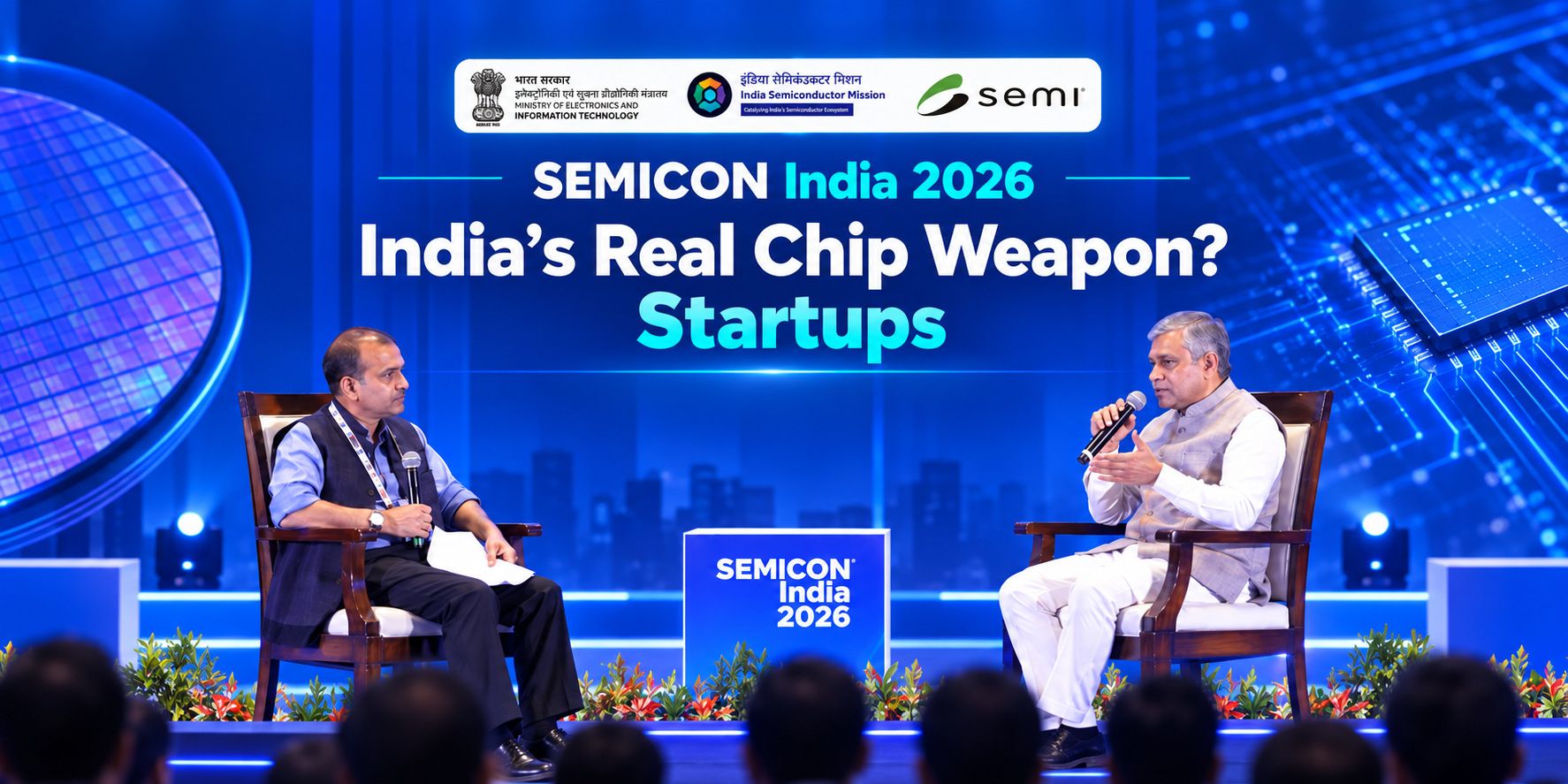
India's chip design startups are set for a significant leg up as the Union government firms up Semicon 2.0, with plans to more than double state-backed support for the segment. Union Minister for Electronics and Information Technology Ashwini Vaishnaw said as much at a fireside chat during SEMICON India 2026, held on 18 September 2026. His remarks, delivered as India's second phase of semiconductor incentives takes shape, put deep-tech chip designers and the country's MSME manufacturing base at the centre of the country's chip ambitions, alongside the marquee investments going into fabrication plants. India's semiconductor push began under Semicon 1.0 six years ago, at a point when earlier attempts spanning nearly six decades had repeatedly faltered, largely due to inconsistent policy and short-term thinking, Vaishnaw said. This time, the government built the programme around a 20-year roadmap and a phased approach, starting with assembly, testing, marking and packaging (ATMP) units and a first fabrication plant in a high-volume, relatively less complex chip segment, the 28 nanometre to 90 nanometre node, which the minister said accounts for close to 70% of global chip volumes. Semicon 1.0 was planned as a six-year programme but was completed in four, he noted, setting up its successor. Semicon 2.0, approved with an outlay of Rs 1,27,500 crore, rests on six pillars, design, materials and machines, additional fabs, more ATMP capacity, research and development, and talent, Vaishnaw said. Chip design has been the most startup-heavy of these so far. Under Semicon 1.0, the government tackled what Vaishnaw called the biggest barrier for young design companies: the high cost of licensing electronic design automation (EDA) tools from vendors such as Cadence, Synopsys and Siemens. Instead of funding individual licences, it routed shared access to these tools through the Centre for Development of Advanced Computing. More than 105 startups went on to become chip designers as a result, and 20 of them raised venture capital funding, reportedly worth close to Rs 800 crore, according to earlier government disclosures. Building on that base, Vaishnaw said Semicon 2.0 is targeting at least 200 deep-tech chip design companies, a scale he described as a potential game changer for India's intellectual property base. MSMEs anchor the precision manufacturing ecosystem Beyond chip design, Vaishnaw pointed to the effect on India's small and medium manufacturers. Citing an industry executive he had met at the event, without naming the company, he said it had already begun exporting components worth around Rs 2,000 crore from India, with close to 90% of that component ecosystem sourced from MSMEs. The precision manufacturing capabilities built up around electronics assembly, he said, are now feeding multiple sectors, including mobile phone manufacturing, aerospace components for companies such as Airbus, and defence, in addition to semiconductors. One chief executive he h