
Rebel Foods' reported early conversations with investment bankers about a domestic listing put a genuine test case in front of Indian public markets: whether the multi-brand cloud kitchen model, running dozens of delivery-only food brands out of shared kitchen infrastructure, can be underwritten as a coherent business rather than a collection of disconnected restaurant concepts. Founded by Jaydeep Barman and Kallol Banerjee, the company built brands including Faasos, Behrouz Biryani, Oven Story Pizza and Sweet Truth, later unifying discovery and ordering across all of them inside a single EatSure app to reduce dependence on Swiggy and Zomato as the primary customer-acquisition channel. The operating logic behind Rebel Foods' model is that a single kitchen facility, run at high utilization, can produce meals for several brands simultaneously, spreading fixed costs like rent, equipment and back-of-house labour across a portfolio rather than a single restaurant concept - the same principle that made cloud kitchens attractive to investors in the first place. Backers including Coatue Management and the Qatar Investment Authority have funded an international expansion into the United Kingdom, Indonesia and the UAE, testing whether the multi-brand, delivery-only format travels beyond the Indian market where food-delivery penetration and price sensitivity created ideal early conditions for the model. The competitive pressure has intensified from both directions. Curefoods, which consolidated brands including EatFit under a single corporate umbrella, has been reported to be pursuing its own IPO timeline, creating a direct comparable for public-market investors weighing cloud kitchen economics. At the same time, Swiggy and Zomato have both continued building their own private-label and dark-kitchen initiatives, using their delivery-platform data advantage to identify underserved cuisines and launch competing brands with none of Rebel Foods' brand-building costs, a structural threat that every aggregator-dependent restaurant brand in India now has to price into its long-term margin assumptions. The financial story Rebel Foods will need to tell bankers centres on brand-level EBITDA rather than consolidated topline growth, since investors will want to see that individual concepts like Behrouz Biryani are profitable in isolation rather than being cross-subsidized by newer, unproven brands still in customer-acquisition mode. Losses have narrowed in recent years as the company has culled underperforming brands and geographies, a discipline that mirrors the broader shift across Indian consumer-tech from growth-at-any-cost toward demonstrated unit economics ahead of any listing conversation. What to watch: whether Rebel Foods discloses brand-level profitability data credible enough to support an IPO valuation, how the international units in the UK and UAE perform relative to the India base, and whether Swiggy and Zomato's own dark-kitchen expansion meaningfully erodes Rebel Foods' addressable market before any listing is completed.
Related Stories
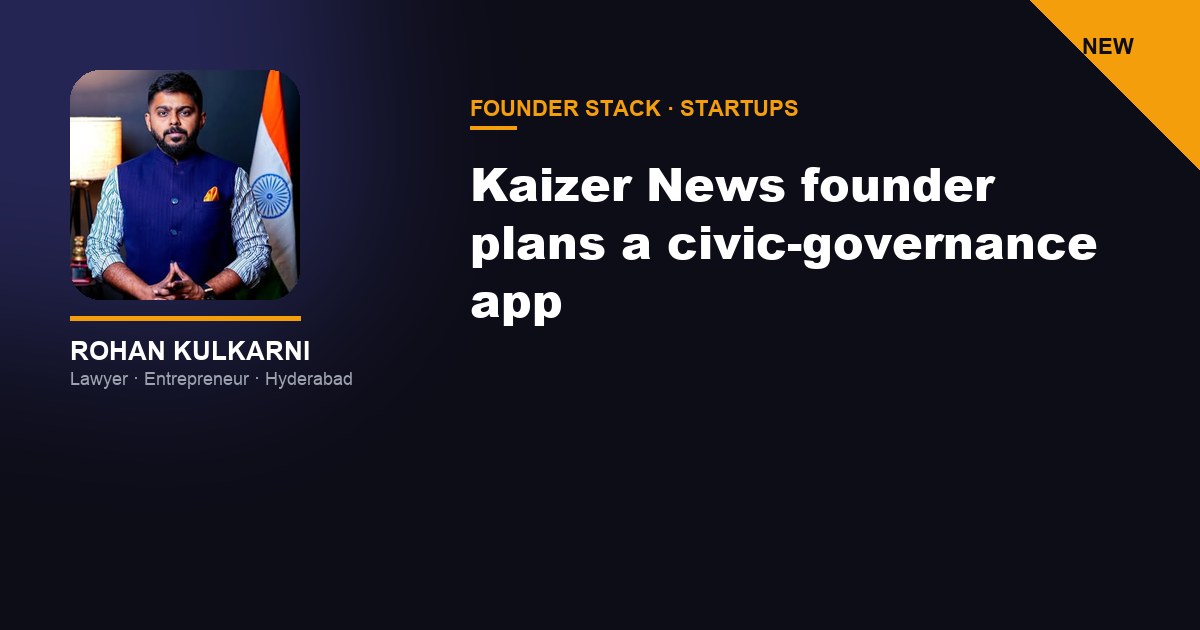 Kaizer News founder Rohan Kulkarni plans a civic-governance app for Hyderabad
 Ninjacart's new funding round is a bet that fresh-produce logistics can finally
 DeHaat's path to profitability runs through the businesses it is shutting down
 Bijak's retreat from marketplace matching into agri-payments is a survival pivot