
Sierra has become one of the clearest test cases for whether AI agents can take on real operational responsibility inside large consumer businesses rather than simply deflecting simple queries. Founded by Bret Taylor, the former Salesforce co-chief executive and OpenAI board chair, alongside Clay Bavor, a longtime Google executive who ran the company's AR and VR efforts, Sierra builds customer-service agents that companies deploy directly into their support channels with the explicit goal of resolving, not just triaging, customer issues, including ones that touch billing, account changes, and cancellations. The company's customer list, including ADT, SiriusXM, Sonos, and WeightWatchers, reflects a deliberate strategy of targeting consumer brands with high support-ticket volume and enough operational complexity that a shallow chatbot integration would fail visibly and immediately. Sierra prices its product partly on outcomes, charging based on resolved conversations rather than a flat seat or API-call fee, a structure that aligns its incentives with customers but also means Sierra absorbs more of the performance risk than a typical SaaS vendor, a trade-off Taylor has said explicitly is meant to force product quality rather than sales-driven feature bloat. The funding trajectory reflects investor confidence that this outcome-based model can scale: Sierra raised at a $4.5 billion valuation in 2025 in a round led by Greenoaks, and by early 2026 reports circulated of a new round in discussions that could value the company north of $10 billion, a remarkable trajectory for a company founded only in 2023. That valuation growth outpaces most enterprise SaaS comparables and reflects the premium investors are placing on companies that can demonstrate AI agents handling economically meaningful, previously human-staffed work rather than augmenting existing staff. The competitive field for customer-service AI agents has grown quickly, with Decagon, Intercom's Fin, and incumbents like Salesforce's Agentforce all pursuing similar territory, and the differentiation increasingly comes down to reliability at the tail: how an agent handles the unusual, emotionally charged, or ambiguous cases that make up a small but reputationally costly share of support volume. Sierra's outcome-based pricing model puts unusual pressure on getting these edge cases right, since failures there directly reduce revenue rather than just showing up in a satisfaction survey. What to watch: whether Sierra's next round closes at the reported higher valuation and what growth metrics justify it, whether outcome-based pricing remains sustainable as Sierra scales into higher-volume, lower-margin customer segments, and whether incumbents like Salesforce and Zendesk narrow the reliability gap enough to slow Sierra's enterprise land grab.
Related Stories
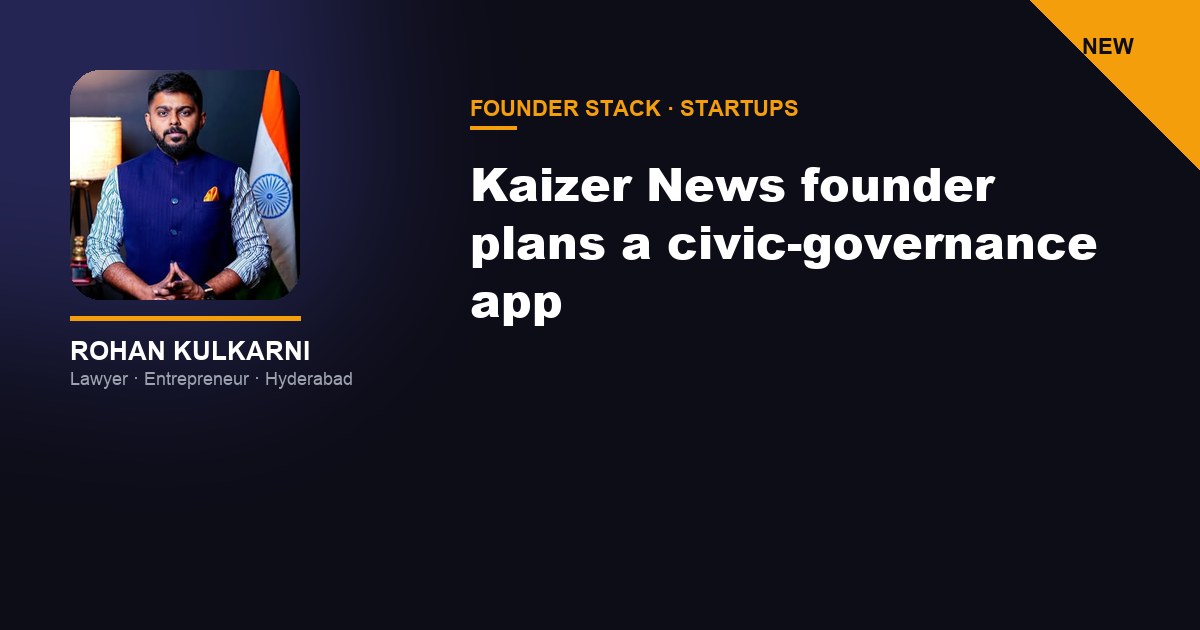 Kaizer News founder Rohan Kulkarni plans a civic-governance app for Hyderabad
 Ninjacart's new funding round is a bet that fresh-produce logistics can finally
 DeHaat's path to profitability runs through the businesses it is shutting down
 Bijak's retreat from marketplace matching into agri-payments is a survival pivot